

English Learning

A Program Where Students Challenge Themselves, Support One Another, and Continue Growing Toward Higher Academic and Global Goals

Madeline
I think our English department is very unique—quite different from elsewhere—so I’d like to learn more about what it offers, especially for students who have a strong background and knowledge of English. David, could you please introduce yourself and tell us a bit more?

David
Sure. My name is David. I’m from Australia, and I’ve been teaching English in Japan for about 20 years. I have a master’s degree in applied linguistics with a major in TESOL, and I’ve taught in many different places. Before working here, I worked in the business field. I also have experience teaching at universities in the Kansai area.
Madeline
Could you give an overview of the English program being offered?
David
Sure. It’s quite an extensive English program, very different from the regular classes in many ways. We offer:
-
An SAT program
-
IELTS programs
-
PCD Program (Dual Diploma Program)
-
The HPU 600 program
The SAT program helps students improve academic English as well as math skills. It’s probably the largest or most famous standardized test for university entrance worldwide. As for IELTS, our course doesn’t just aim for high scores; it also focuses on building students’ overall academic skills. Through
the IELTS program, we’ve seen students scoring 7.0 and 7.5, which is quite good. With the SAT program, students have also done well, successfully taking the test and earning solid scores. We also have a dual diploma program, allowing students to graduate not only with a Japanese high school certificate but also with an equivalent American high school certificate. Meanwhile, the HPU 600 program lets students earn university credits by taking courses from an American university online—at the same time as they’re doing their regular studies here.
Madeline
So, what kind of students typically enroll in this type of study or learning?
David
Usually, the students in these programs are at a very advanced level. We have international students taking these courses, as well as high-level Japanese students. They’re very driven—wanting to use the skills and results they gain here to enter universities either in Japan or abroad, and also to keep developing their abilities. Our main idea is not just to help them get into universities, whether domestic or overseas, but to ensure they have the skills to succeed once they get there.
Madeline
Speaking of students pursuing higher education, David mentioned that earlier. Are you personally taking any of these programs? First, could you introduce yourself a little?
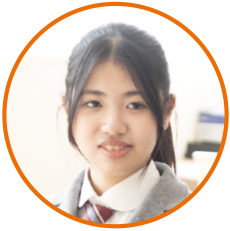
Yurina
Starting in April, I’ll be a third-year high school student. I’m originally from the Philippine but I moved to Japan when I was in elementary school. I’ve taken the TOEFL before, and now I’m currently taking SAT prep.
Madeline
You said you arrived here when you were in elementary school. Would you say your primary education was in Japanese or English?
Yurina
It was in Japanese, but as a Filipino student who had just come to Japan, the Japanese school I attended didn’t pay much attention to me. They acted like I was already supposed to know everything. I didn’t know much about Japanese customs or language, so I’d get scolded for things without actually understanding why.
Madeline
So, how did things change when you entered HIS? What happened?
Yurina
It changed so much—it changed everything about my education. I actually enjoy going to school now, because there are teachers who really help me understand both Japanese and English. I’m not afraid to try new things anymore, because I know there are a lot of teachers willing to help me.
Madeline
How did your English education change or improve?
Yurina
Ever since I came to HIS, my English has improved a lot. Before coming here, I only knew conversational English, but now I’ve learned a lot of academic English and the vocabulary and phrases you need in society.
Madeline
What are your plans after high school?
Yurina
I would like to attend a university focused on international studies and take classes taught in English.
Madeline
So, taking classes taught by English-speaking professors is quite a big challenge. How do you feel about it?
Yurina
I really like challenges. Ever since I came to HIS, I’ve found challenges to be fun, so I think it’ll be a good experience for me.
Madeline
And how are your teachers, especially with English? How are they helping you prepare?
Yurina
I’ve been taking lessons with Mr.David and Mr.Steve. I worked on IELTS previously, but now I’m studying for the SAT—both English and math.
Madeline
How are you finding SAT English and math?
Yurina
SAT English is a bit difficult because it’s all new to me, and math is really tough because I came to Japan with no Japanese knowledge, so I was never really taught much math. Still, I’m ready to learn more.
Madeline
Wow, you’re very motivated, and that’s truly wonderful. David, what are the main instructional methods you use in your teaching?
David
Well, I think I speak for everyone when I say we use a very eclectic approach. All our students have diverse needs and come from different backgrounds in terms of English ability, strengths, and weaknesses. We try to be as flexible as possible, but we really want a student-focused classroom where students help each other learn by working in realistic, task-based situations, often being tested rigorously but with lots of support. I see the teacher as just setting the stage for the students to learn.
Madeline
You mentioned diverse backgrounds and varied English levels within the same class. How do you handle differentiation?
David
At HIS, we have many teachers, so it’s possible to run multiple classes simultaneously. Students with drastically different abilities can be grouped according to their needs. But I actually believe that having different levels in one class isn’t necessarily a problem—it can be beneficial. I like having a lot of student-to-student interaction, and they can often help each other just as well as a teacher can. So, different levels can actually push everyone to improve.
Madeline
So it’s more of a student-led type of learning, with the teacher as a facilitator?
David
Exactly, definitely. I think the teacher’s role is to facilitate the learning environment. We’re there to help if they need it—providing materials and having a curriculum plan—but the focus is not on me, it’s on the students. They do as much as they can through practical exercises and supporting
each other. Of course, if anyone needs help, the teachers are available to walk them through it, providing scaffolding to help them grow.
Madeline
I’ve heard that some students who complete the HIS English programs go on to study at overseas universities. How do you think they will perform after entering university?
David
I think they’ll do quite well once they complete these programs. They’ll have the academic skills to meet any challenges. Many of them are highly motivated. The courses we have don’t just help them get into college, but ensure they can really succeed once they’re there. And because the student body is so diverse, they also learn a lot from each other—culturally and internationally.
Madeline
For students who might be interested in our school, do you have a message?
Yurina
If anyone’s interested in our school, my message is that it’s honestly a really great place. It’s not just about learning academic English—the diverse background here lets people really feel welcome. My experience in other Japanese schools was different, but here, the teachers genuinely want to help you. Don’t be afraid to ask questions or participate in a lot of things. I’m really glad I did!
Madeline
If you don’t mind, could you tell us about some extracurricular activities you’ve been involved in?
Yurina
Sure! I volunteered for the school. I won first place in an English speech competition in Okayama. I got second place in an English essay contest, and I joined a debate competition with my friends. I did a lot of other things—international exchange events where diverse people can come together, and lots of volunteering. I don’t remember everything.
Madeline
I hope you’ve put all of that in your portfolio. David, do you have any message for anyone who might be reading the website or making inquiries?
David
Sure! Please come to Hiugene International School. I think we can help students achieve great things. It’d be wonderful to meet anyone interested.
Admissions
To help you learn more about our school, please complete this online form and one of our admission team members will contact you as soon as possible.
Contact